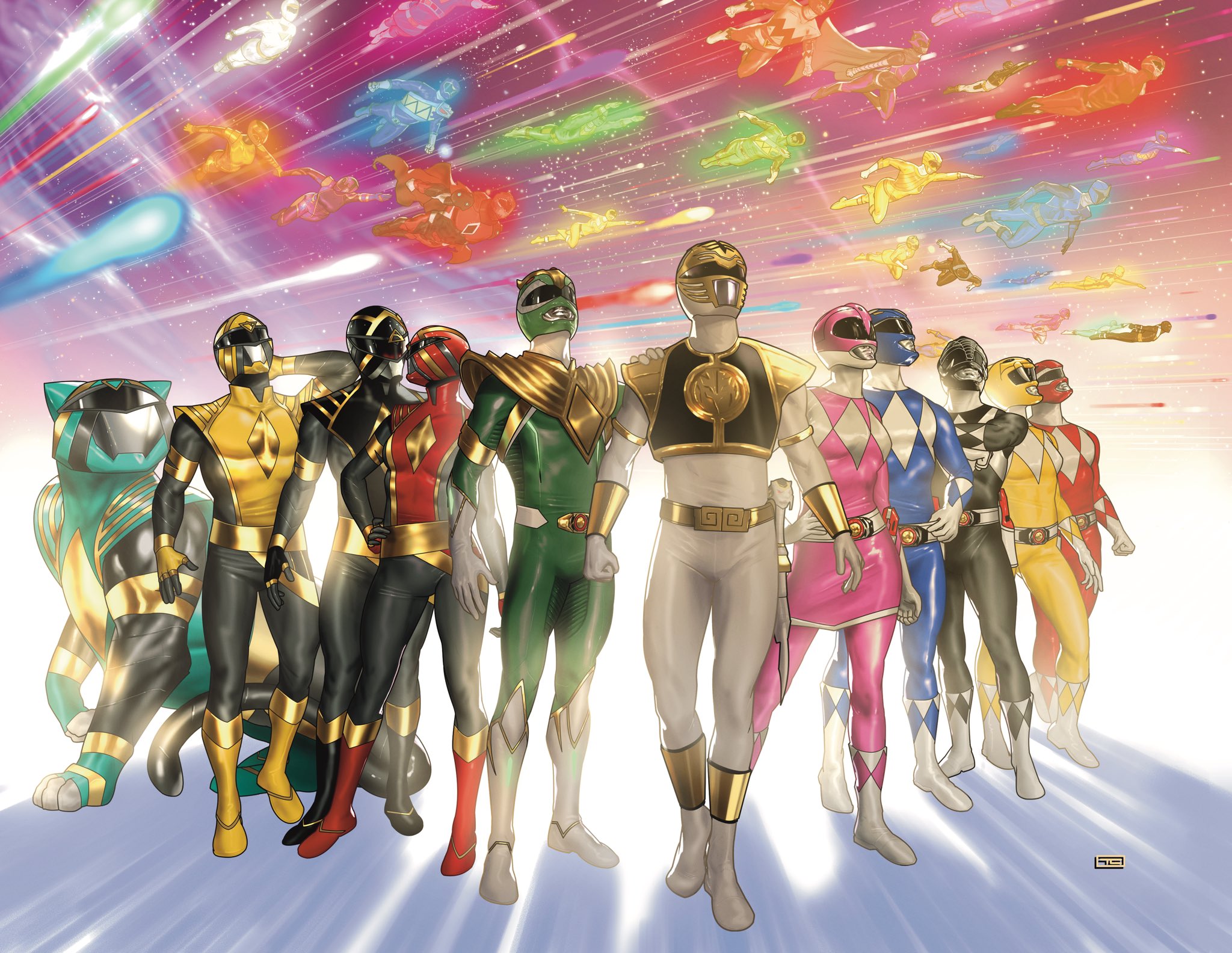
Over the past four years I’ve read over 6,000 issues of comics, but I always end up coming back to one series over and over again; BOOM! Studios’ Mighty Morphin’ Power Rangers saga. To me, this series is everything I need in a comic; a great story, amazing character moments, good humor, and a satisfying ending. Although the Power Rangers are often seen as a children’s property, this series elevates the franchise up with the big hitters on Marvel & DC’s roster, so let’s talk about why I love it and why you should read it.
The Shattering of Tommy Oliver
It’s very rare nowadays to find a comic series that has a cohesive vision for more than 20 issues, and although this series changes hands from writer to writer, the overall plot still fits together and feels like a natural progression for all these characters, rather than a forced plot to sell books. The first “era” of this series, written by Kyle Higgins, is a masterclass on how to adapt and modernize a property like this by taking everything people remember, and flipping it on its head in a way you wouldn’t expect. Although I’ve never been a massive Tommy Oliver fan, I love that the first 30 issues are framed from his perspective, opening issue #0 with a “flashback” of Tommy being evil is a great bit of both laying the groundwork for what the reader needs to know, but also setting up the big reveal and conflict of your book. I’m traditionally not the biggest fan of the “other dimension hero is a villain” trope, but in this scenario, it works so well for me. Lord Drakkon is a very fun villain, I love that he is a version of Tommy who simply chooses to be bad, not because of mind control or anything crazy, but because it’s all he’s ever known. It puts the character on a great parallel course to the main universe Tommy Oliver that’s learning he isn’t defined by his past as a villain, that he can be better than his darkest fears. This character journey comes to a head in the Shattered Grid event, where Drakkon wants complete access to the Morphin Grid, but the only thing that can stop him is literally a ghost of his soul in the dead main universe Tommy Oliver. To me, this is just a perfectly well done character moment that creates a definitive end, but also sets the characters up for a fantastic continuation. Drakkon isn’t redeemed, but he’s maybe not completely lost in the dark. This isn’t just a great villain story—it’s the thesis statement for the entire saga: we are not defined by our darkest moments.

Fall of the House of Zordon
My personal favorite era of the Power Rangers comics is the one written by Ryan Parrott that starts in issue #40 and runs all the way through to #100, often dubbed the “Unlimited Power” era. For me, this era focuses on to primary characters, Jason Lee Scott and Zordon of Eltar, both of which demonstrate the weight of leadership and how sometimes you need to find your own path instead of trusting the natural order of the world. For Zordon, we get to see a lot more of his past as an Eltarian Guardian in this era, where we learn where his deep rooted belief in people and doing right stems from. Giving Zordon his own “team” of heroes with Zartus & Zophram is fantastic, it allows us as a reader to see a side of Zordon that we had never seen before, we learn about his dreams of living a peaceful life and not wanting to fight in these wars. What turns Zordon into the sage elder we’re familiar with is the manufactured fall of the Guardians, forcing Zordon to remain in a tube to mentor heroes throughout the galaxy and spreading what he believes are the altruistic principles of Eltar. I love making Lord Zedd Zophram, it adds such a compelling depth to the character while also adding more context to his hatred for Zordon. All of this results in Zordon challenging everything he believed about his people and learning to accept that he can’t make all the decisions himself.
The other character that this era highlights is Jason Scott. In the first era of comics, Jason isn’t a major focus despite being the red ranger and leader, so when this era rolls around, a lot of the focus shifts to him and how he weighs doing the right thing and sticking by Zordon’s ideals. This starts right away by revealing that Jason, Trini, and Zack didn’t go to Switzerland, but instead formed a new ranger team, the Omegas. I love the Omegas twist, it gives a great reason to split the original 6 while still keeping and developing them. I also love that Jason has grown so much that he believes the benefit freeing Drakkon provides heavily outweighs the disappointment Zordon will have in him. He doesn’t care what people think, he only wants to save as many people as possible. This event leads to something we rarely see in this franchise; space rangers that are effectively outlaws and need to resort to less “good” avenues to get the results they need. This urge of Jason’s to want to save everyone eventually culminates in him misplacing his trust in Andros and releasing the Death Ranger. This leads to a fantastic dissection of what grief can lead to and how different people learn to cope with it. Jason refusing anyone’s help after his mother passes, and claiming he’s perfectly fine, is tough to read in the best type of way. When he gets possessed by Death, it gives Jason an ultimatum; give in to his grief and remain happy, or cut himself off from the Morphin Grid to save everyone. The ending of Jason listening to his last voicemail from his mother truly puts a capstone on the era, it’s one of my favorite comic sequences of all time, not just for the beautiful art that accompanies it, but for the emotional impact that such a mudane and regular thing has in this context.

The Burden of Billy Cranston
I’ve never been a big Billy fan, he was never the cool leader like Jason or Tommy, was never as funny as Zack, and didn’t have the unique stories of Kimberly or Trini. That being said, there’s something to be said about how Billy is secretely the best main character of the entire series, and how that takes center stage in the “Darkest Hour” era. Throughout the previous two eras, Billy gets some quality moments like his sequence finding Zordon in the Morphin Grid, but in Darkest Hour, Billy is center stage and gets so many great moments. When Dark Spector finally takes over the Grid and effectively wins, no one wants to admit that they can’t win, but Billy refuses to accept defeat, and over time becomes more extreme in how he wants to fix everything. He sees only one option; shattering the grid again in the hope that it can fix itself like it did in the first era, but for all the characters know, that could lead to even more turmoil than they’re currently dealing with. To me, this dilemma is what elevates Billy to one of my new favorite characters. He knows the risk, he knows he isn’t justified in doing it, but he also knows no one is coming to save them, they’re out of options and that’s extremely isolating. It’s the acceptance of this that, to me, allows Billy to complete his arc from the closest thing Zordon has to a contemporary to surpassing Zordon himself and spending the rest of his life atoning for it. The final sequence of Billy, years later, still working to fix his mistake is great. It creates both a satisfying conclusion to the story that started with Shattered Grid, while also telling the reader that this world will never end, there’s always more to fix but that you can always find light in even the darkest of times.

Wrap Up
In the end, I hope you can see why I love this comic series so much. Be it Billy and his arc, Jason and Zordon mirroring each other, or even how the first villain takes an exhausted trope and revitalizes it, there’s so much to love in this series and I highly recommend you read the series. You don’t need to love Power Rangers, you just need to like people trying to do the right thing.
So what are your thoughts? Have you read this series? If not, will you?
Leave a Reply